The Architecture
of Your Values
KSVM is a flexible framework for understanding and describing human values. Values are a key element of human psychology which influence the content we consume, the products we buy, and the way we vote.
There are sixteen value types. Discovering your own unlocks powerful and usable self-knowledge, and familiarity with the types can revolutionize how you interact with your own customers, students or even friends and family.
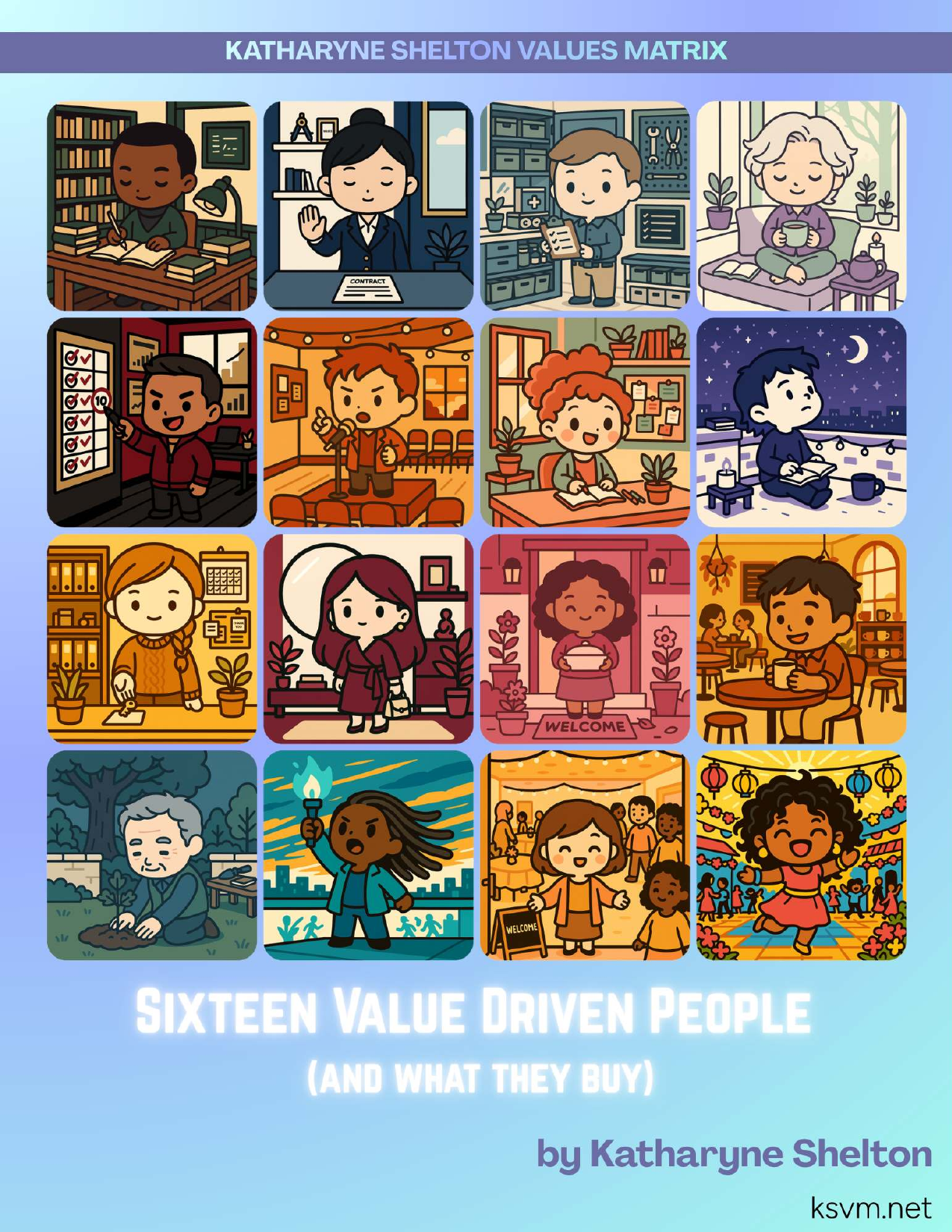
Creating books, products or content? Grab my free creator's guide Sixteen Value-Driven People. This extensive PDF book includes detailed buyer profiles for each of the 16 value archetypes, as well as specific suggestions of products and books to create.
For Creators
Knowing your customer's values is more important than demographics when it comes to understanding their buying motivations and decisions. Their value type tells you what problems they might be looking to solve, what language they respond to and what kind of product meets their deeper needs.
- Each of the 16 types has a distinct buyer psychology: different motivations, different fears and different criteria for a good purchase
- Design products, offers, and messaging that speak directly to what each type actually cares about
- The framework works for physical products, services, content, and positioning strategy
For Psychologists
The KSVM gives you a precise vocabulary for the values dimension of personality, so you can name what you are observing rather than reaching for approximations.
- Each value includes a shadow spectrum: the absent state, the healthy expression, and the excess state, all named
- The shadow dynamics built into the model map to presenting difficulties in a way that is clinically useful
- Works as a standalone assessment or alongside existing personality and attachment frameworks
For Commentary and Analysis
The KSVM gives cultural and political analysis a sharper tool. The most revealing thing about any public figure, movement, or institution is the gap between the values they claim and the values they enact.
- The 16-type coordinate system lets you place a subject precisely rather than describing them in clumsy or heavily politicized terms like left and right
- The shadow states are especially useful for criticism: they name the distorted form of a value without reducing it to a moral judgment
- Applies to politicians, parties, ideological movements, organizations, subcultures, and historical periods
There are 16 possible four-letter codes. Each code connects directly to a value. For example, the code for the value Mastery is SAJD.
Each letter represents your standing on each of four axes. The first two letters (SA) describe your foundation. The second two (JD) are your expression. SAJD means your foundation is Self + Anchor, expressed through Justice + Discipline.
These are the sixteen distinct values with their codes, organized into four foundational quadrants.
The foundation axes determine whose world the value is concerned with and whether it orients toward stability or change.
The first axis identifies whose world the value is primarily concerned with. Self-oriented values (S) center on the inner world, personal development, and private experience. Others-oriented values (O) extend outward toward relationships, communities, and the world beyond the individual. Neither orientation is morally superior; both poles contain some of the most significant values in the matrix.
For example, in the Self · Anchor quadrant, these two axes produce:
The second pair of axes create four expressive quadrants and complete the four letter codes.
The third axis identifies the motivating ethic. Justice values (J) are structured, principled, and meritocratic; they concern what is right and what is earned. Compassion values (C) are relational and responsive; they concern what is needed and what connects people to each other.
Values in this quadrant concern who you are when grounded. They build inward stability, personal integrity, and the private foundation from which a well-lived life is constructed. SA values are structural in the most fundamental sense: the infrastructure that supports everything built on top of it.
Values in this quadrant concern what you build in relationship. They create reliable bonds, earned trust, and the structures that hold people together over time. OA values are load-bearing; invisible when they function, catastrophic when they fail.
Values in this quadrant concern who you are becoming. They fuel personal transformation, inner exploration, and the willingness to change. SE values are defined by productive restlessness; they sustain the question of what more is possible.
Values in this quadrant concern what you change in the world. They drive collective growth, liberation, and the kinds of transformation that extend beyond any single relationship. OE values are expansive, sometimes destabilizing, and necessary for any society that intends to improve itself.
Values in this quadrant are concerned with principled structure. They combine a drive for fairness with the rigor to uphold it: building systems, enforcing standards, and holding lines that protect what matters.
Values in this quadrant are concerned with caring structure. They combine warmth and attentiveness with the commitment to show up consistently, sustaining relationships through reliable action, not feeling alone.
Values in this quadrant are concerned with principled liberation. They combine a drive for truth and fairness with a refusal to be constrained by convention: questioning systems, challenging authority, and insisting on change.
Values in this quadrant are concerned with open-hearted expansion. They combine deep care with a restless desire to grow: drawing people in, exploring together, and following what feels alive rather than what is prescribed.
Every value has three states. The healthy state describes how the value looks in its optimal form. There are also shadow states which describe too little or too much of the value. These are valuable for diagnostic purposes.
The value is absent, suppressed, or insufficient. Its absence produces recognizable patterns of avoidance, numbness, or self-defeat, each with a distinct name in the framework.
The value is active and integrated. It carries a specific name that describes the particular quality of that value when it is functioning at its best, not just a label of approval.
The value has been overtaken by excess and has begun to constrain or harm. Even the most essential values, past their limit, become cages. This state is named and described in full.
Each of the sixteen KSVM values has a set of subvalues mapped to it, over a hundred specific words and concepts. These are the terms people actually use when describing what matters to them: grit, devotion, tact, reverence, wit. Browsing them is often the fastest way to locate yourself or someone else in the framework. Use the Subvalues tab to explore them.